Maya Tutor
Learning games for kids
A game where every lesson is a school topic. Children answer with a tap, Maya explains when they slip, and every finished lesson opens another part of her world.
What kind of game is Maya?
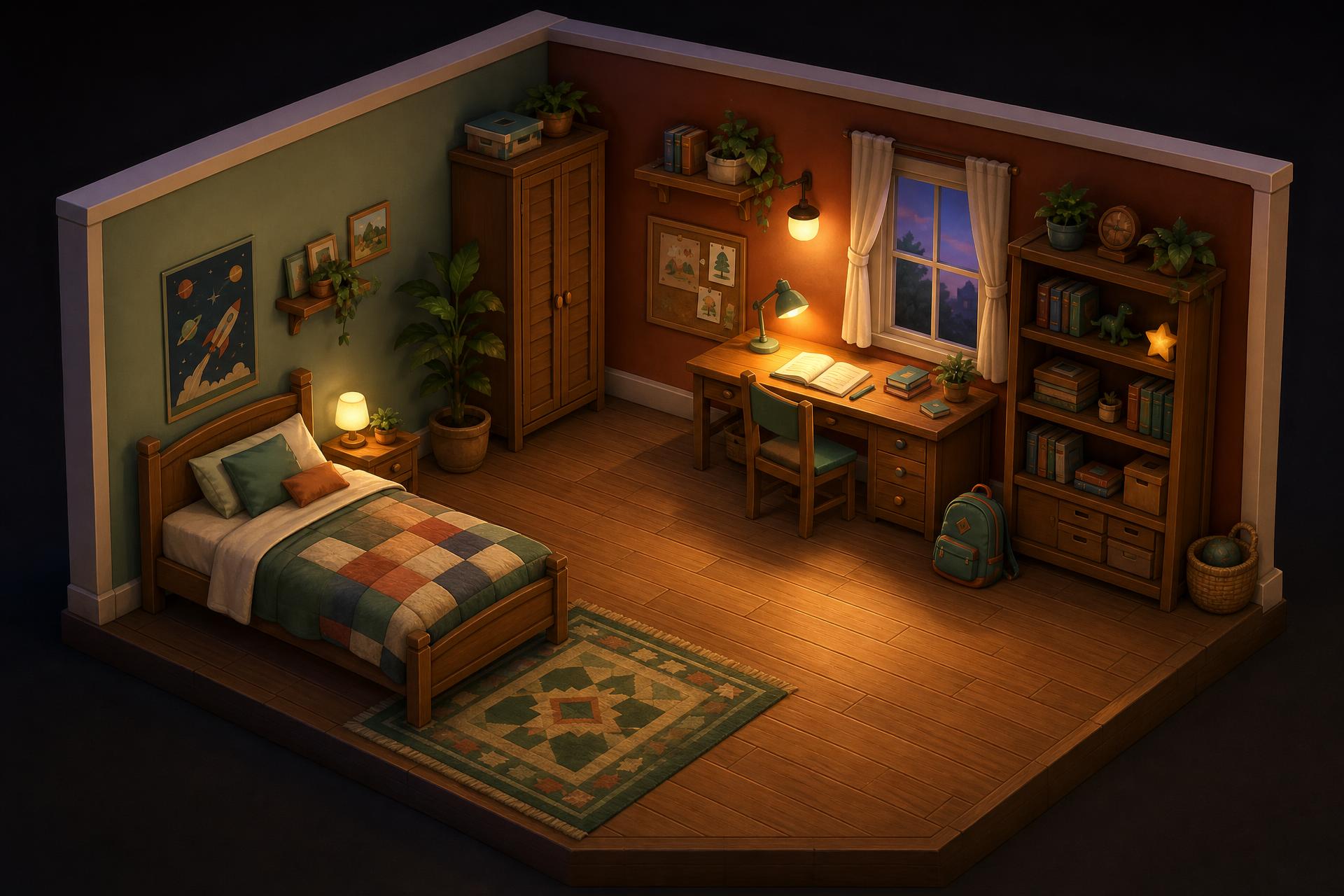
Maya is a world your child moves around in: a room, a character who talks to them, and places that open up as lessons are finished. The lessons themselves are school topics — adding up to 20, reading a map, telling a noun from a verb.
It is a game in how it feels: there is a world to discover and a character waiting in it. But every step is a real lesson, with questions answered by a tap and an explanation after a slip.
The material is organised by grade and by subject: math, Hebrew, science, English and world studies.
How does a lesson with Maya go?
Inside the game, a lesson has the same shape every time:
- Your child tells Maya what the class learned today, or shows her a photo of the worksheet.
- Maya teaches that topic with them, in short steps, at their grade.
- She asks questions they answer with a tap — no typing, no blank page.
- When an answer is wrong, she does not just say “try again”. She explains why that answer was tempting, and what was missing to reach the right one.
- She remembers what did not land, and comes back to it in later lessons.
Which ages is the game for?
Children in grades 1 to 6, roughly ages 6 to 12. Younger children can play too: they answer with a tap, and Maya says things out loud.
Older children can go further — the catalog reaches grade 10 — and a child who needs to go back to an earlier grade’s topic can do that too.
There is no chat with other children in the game, so your child can play on their own while you are in the next room.
What happens when a child gets it wrong in the game?
A second grader gets 9 + 6 and three answers to choose from: 15, 16 and 3. Say they tap 16. It is a familiar slip: they counted all the way up from 1, and counted one too many on the way.
Maya does not just say “wrong”. She explains why 16 looked right — a long count from 1 is easy to slip on — and then shows the short way: start from the bigger number, nine and one make ten, five are left, fifteen together.
The next time a sum like that comes up, she checks whether the short way stuck.
Is Maya safe for a young child?
Maya is built for children with a parent nearby, and the rules are written into her legal pages, not just promised on this one.
- Maya does not ask a child for an email address, a precise location or a friend list.
- There is no chat between children, no public feed and no ads in the lesson.
- Lessons that go through a language model stay locked until a parent confirms a link sent to their email.
- From the parent screen you can pause those lessons and delete the copy kept in the cloud.
- Children’s information is not sold, and there is no targeted advertising.
The full details are in the children’s privacy notice and the safety page, linked at the bottom of this page.
Maya or a private tutor: which does your child need?
Both help, but they answer different needs. Here they are side by side:
| Compared | Maya | A private tutor |
|---|---|---|
| When | Whenever your child opens it — the same evening the class learned the topic. | At a time booked in advance, when the tutor is free. |
| How long | One topic per lesson, at your child’s pace. | A fixed length agreed in advance. |
| What it covers | What the class learned today, at your child’s grade. | Whatever you agree with the tutor. |
| After a wrong answer | Explains why the answer was tempting, and remembers to come back to it. | Depends on the tutor. |
| Who teaches | Maya, on a screen, with lessons written in advance. | A person who sees and hears your child and can change the plan as they go. |
A human tutor is the better choice for exam preparation, for teenagers, for practising a spoken language, and for a child who needs a person beside them. Maya is for the everyday: the evening after school, when a topic did not land and nobody is free to explain it again.
You can also have both: if your child sees a tutor once a week, Maya can cover the other evenings.
Questions parents ask
Is it a game or schoolwork?
Both. It feels like a game, and inside it your child learns real school topics: math, Hebrew, science, English and world studies.
Can my child play without me?
Yes, once a parent has set it up with their email. There is no chat with other children, no public feed and no ads in the lesson.
What does my child need to play?
Just a web browser at maya-tutor.com, or an iPhone with Maya from the App Store.
Does the game follow my child’s grade?
Yes. Lessons are written by grade, from grade 1 to grade 10, so the game keeps pace with what your child’s class is learning.
Which languages does Maya’s screen come in?
Eleven: English, Hebrew, Spanish, Portuguese, French, German, Russian, Arabic, Hindi, Chinese and Japanese.
Every lesson by grade and subject
Every lesson has its own page: the topic, the mistake it was written to catch, and a sample question.
Subjects